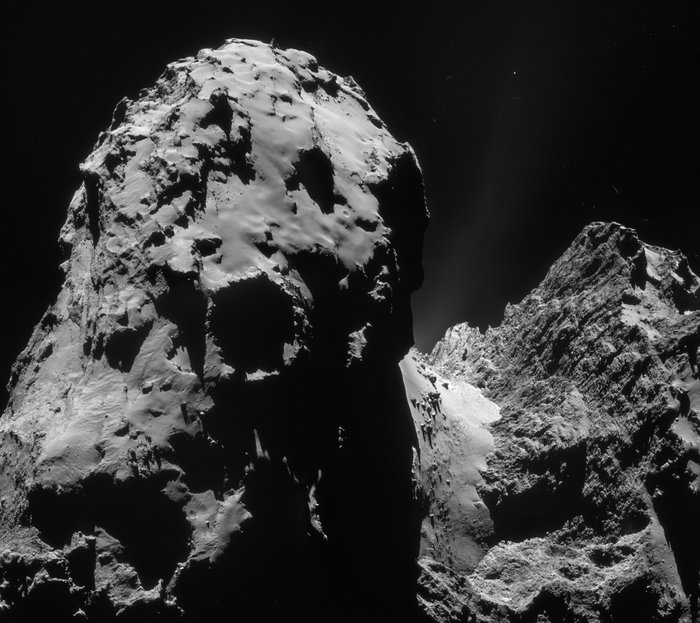
On June 13th 2015, the robot-lab Philae woke up on the comet 67P/Churyumov-Gerasimenko to resume a series of experiments interrupted seven months ago. These experiments were scheduled using Constraint Programming, and researchers of the team ROC developed propagation algorithms to help the Scientific Operations and Navigation Centre (SONC) to efficiently achieve this task. The Rosetta/Philae mission was launched in 2004 and it took more than ten years for the spacecraft, Rosetta, to reach its destination after a 6 billion kilometres long trip. On November 12th 2014, the lander module, Philae, was released and landed on the ground of the comet. Philae is fitted with ten instruments (see Figure 1) to conduct the experiments elaborated by as many research teams across Europe. These experiments, should they be imaging (CIVA, ROLIS), sampling (SD2, COSAC, PTOLEMY) or other types of signal analysis, correspond to sequences of activities constrained by two extremely scarce resources:
...